
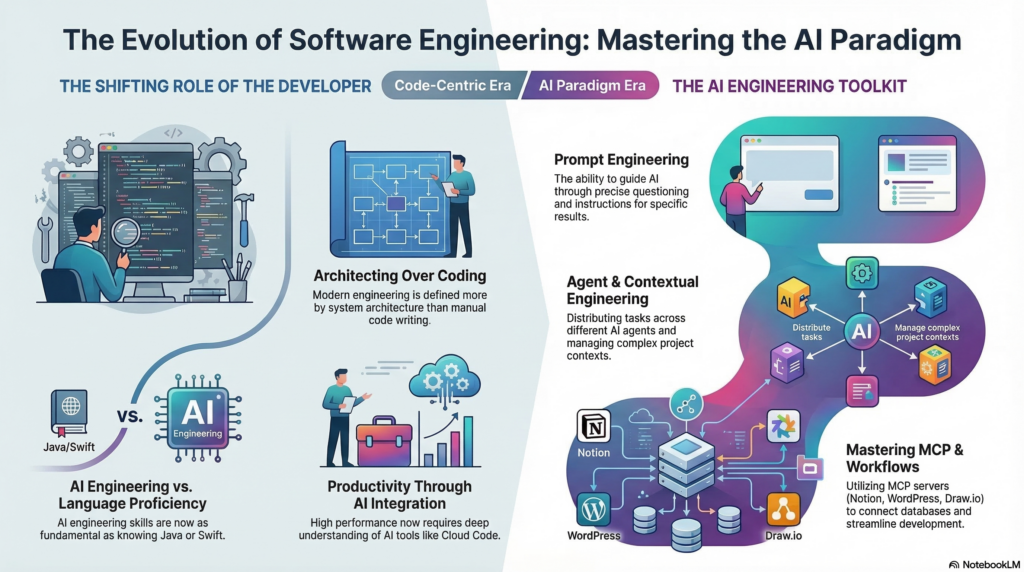
The landscape of software development is undergoing a profound transformation. AI engineering is becoming as fundamental as traditional programming languages like Java or Swift. Modern developers must transition from being mere coders to architects who can manage complex systems through contextual, prompt, and agent engineering. By leveraging tools such as Claude Code and MCP servers, engineers can significantly boost their productivity and task management. Continuous learning is essential—specifically through studying Anthropic’s API and advanced workflow integration. Ultimately, future professional success depends on one’s ability to precisely instruct and distribute tasks using artificial intelligence. This evolution marks a new era where human oversight and strategic design outweigh the importance of manual coding skills.
How Does Architecting Software Differ from Traditional Coding in AI?
In the evolving landscape of software development, the distinction between traditional coding and architecting is defined by a shift from manual syntax creation to the strategic management of AI-driven systems.
The differences can be broken down into several key areas:
From Language Proficiency to AI Engineering
Traditional coding relies heavily on mastery of specific languages like Java or Swift. However, language skill alone no longer guarantees high productivity or performance. Instead, modern architecting requires “AI engineering,” which encompasses prompt engineering, context engineering, and agent engineering.
Task Distribution and Management
While traditional coding often involves writing specific logic for every function, architecting involves distributing various tasks to different management systems. Through agent engineering, an architect manages how different jobs are allocated across a workflow to ensure the system operates more efficiently.
Context and Integration
Architecting goes beyond writing code to include contextual engineering, where the focus is on how a system interacts with external tools and data. This involves using MCP (Model Context Protocol) servers to connect AI with databases and platforms like Notion, WordPress, and draw.io.
Instruction vs. Manual Construction
A primary difference lies in prompt engineering, where the architect’s role is to provide precise instructions and questions to guide the AI toward a desired result, rather than manually constructing the logic from scratch.
The Core Skills Required for Modern AI Engineering
- Prompt Engineering — The ability to precisely instruct AI systems through well-crafted prompts and questions to achieve desired outcomes.
- Context Engineering — Understanding how to provide the right context to AI systems, including integration with external tools, databases, and platforms through protocols like MCP.
- Agent Engineering — Managing and distributing tasks across AI agents and workflows, ensuring efficient allocation of jobs across the system.
- MCP Server Integration — Connecting AI tools like Claude Code with external services (Notion, WordPress, databases, draw.io) to create a cohesive development ecosystem.
- Continuous Learning — Staying current with evolving AI capabilities, particularly Anthropic’s API and advanced workflow integration patterns.
The Role of MCP Servers and Agentic Prompt Engineering
MCP (Model Context Protocol) servers serve as the bridge between AI assistants and external tools and data sources. They enable:
- Database connectivity — Direct interaction with PostgreSQL, MongoDB, and other data stores
- Platform integration — Seamless connection with tools like Notion, WordPress, and design platforms
- Workflow automation — Enabling AI agents to perform complex multi-step tasks across different services
Agentic prompt engineering takes this further by:
- Distributing complex tasks across multiple AI agents
- Managing workflows where different agents handle specialized subtasks
- Providing strategic oversight rather than manual step-by-step coding
- Creating systems where human architects design the overall approach while AI handles execution
Ultimately, architecting is described as being “beyond” what AI can do on its own, requiring the engineer to oversee the entire ecosystem of skills, tools, and workflows to achieve high-level results. The future belongs to those who can think architecturally and leverage AI as a powerful tool under human direction.